
Polaris UniverseOne™ Motion Control Simulator

Home / Products / Polaris Components / Software / Polaris UniverseOne™ Motion Control Simulator
Polaris Communication Library API

Polaris MotionSIM2™ Motion Control Simulator

Bringing a high-performance machine tool to market requires more than good mechanics and fast hardware. It requires predictable motion behavior, early integration confidence, and a development workflow that doesn’t stall while prototypes are still being built. Polaris MotionSIM2™ is the Polaris UniverseOne™ motion control simulator designed to help OEMs develop, validate, train, and demonstrate their machines using a hardware-independent virtual machine—before, during, and after the first physical system is available.

At its core, Polaris MotionSIM2 is a software program that simulates the generation of exact toolpaths without requiring Polaris Motion hardware. The simulator accepts G-code and generates position setpoints for the machine defined in your configuration file. The simulated toolpath adheres to your machine constraints, including axis travel limits, velocity limits, and acceleration constraints. This enables teams to run part programs virtually, validate motion intent, and identify issues early—without consuming shop time or risking damage to expensive equipment.

Hardware-Independent Process Development

MotionSIM2 decouples process development from hardware availability. Engineering teams can iterate on part programs, motion sequences, and machine behaviors using a consistent virtual machine definition—whether they are working toward a first prototype, a redesign, or a new application rollout. This reduces late-stage surprises and creates a shared reference point across mechanical, electrical, controls, and software stakeholders.

Making the Machine: Design & Configuration Verification

During the design phase, MotionSIM2 becomes a practical engineering tool for machine architecture decisions. Machine design engineers can evaluate different configurations—axis strokes, speeds, accelerations, and coordinated motion strategies—before committing to expensive components.

MotionSIM2 also supports machine tool configuration verification, helping confirm that your configuration matches expectation prior to commissioning. For example, teams can validate anticipated Mercury™ network devices and registers, reducing integration friction when hardware arrives and minimizing first-power-on uncertainty.

Parallel Software Development Without Hardware Bottlenecks

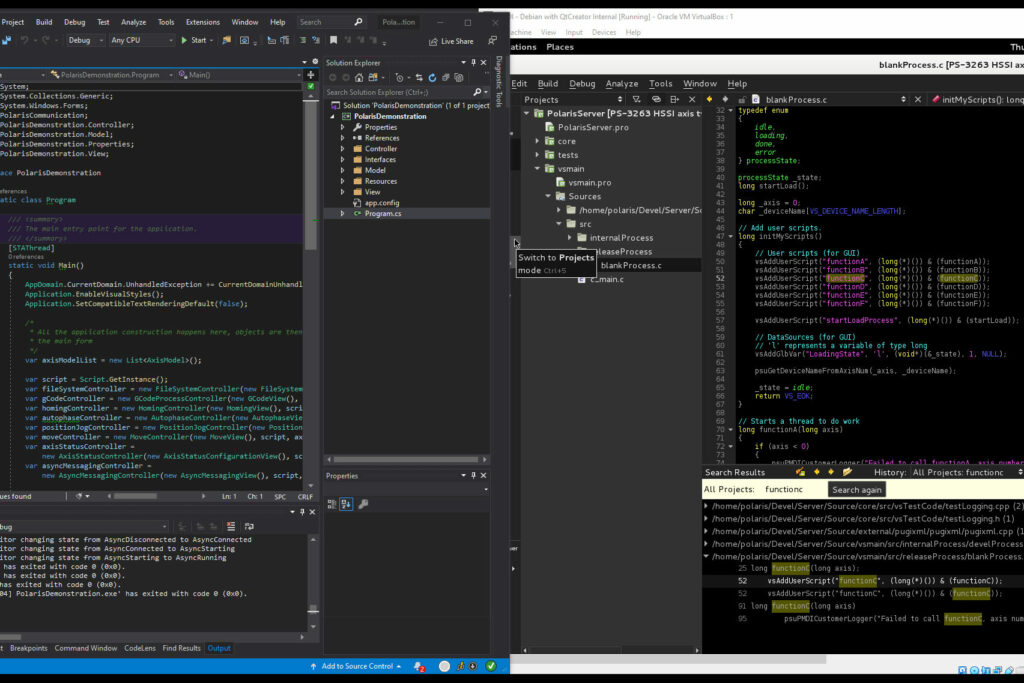
Software teams don’t want to wait for a finished machine to start building the operator experience. With MotionSIM2, software developers can implement and test UI workflows, part program handling, sequencing, and system behavior without needing continuous access to a physical machine tool (or even any Polaris hardware). This is especially valuable when multiple developers are contributing and hardware access is limited.

To support realistic integration workflows, MotionSIM2 can simulate aspects of the environment, including:

  • Simulated I/O loopback to test interlocks, sequencing, and automation logic
  • Simulated software/hardware interactions for integration testing
  • Error responses such as limit errors and constraint violations, allowing teams to validate alarms, recovery flows, and operator messaging before commissioning

Setpoint Verification, Visualization, and Test Plans

MotionSIM2 enables setpoint verification—confirming that generated motion commands are consistent with machine limits and expected behavior. It also supports workflows where generated setpoints can be paired with HSDAQ-style visualization, helping teams compare motion intent, examine trajectories, and build confidence in part program execution.

For OEMs, MotionSIM2 strengthens internal quality systems by supporting structured test plans. Use the simulator to run repeatable validation routines, regression tests, and acceptance checks across many part files—before hardware is fully available and throughout ongoing releases.

Operator Training and Safer First Deployments

Commissioning risk isn’t only technical—it’s also human. MotionSIM2 provides a virtual machine tool for operator training, allowing customers and internal teams to learn workflows, understand kinematic response, and experiment safely. Operators can rehearse procedures and observe how the system behaves under normal and fault conditions before the first real deployment—reducing scrap, avoiding crashes, and accelerating ramp-up.

MotionSIM2 can also support simulated concepts for offline obstacle avoidance in machine tool or robotics environments, helping teams reason about motion envelopes and interference risks earlier in the process.

Taking the Machine to Market

MotionSIM2 is also a practical commercialization tool. Sales engineers and business development teams can use it as a demonstration product—showing machine capabilities on a laptop or in online sessions even before the machine is in full production. Prospects can see how parts run, how motion behaves, and how the operator workflow feels—without needing physical access to the machine.

Performance Forecasting

MotionSIM2 supports part cycle time estimation to help OEMs evaluate throughput, compare process alternatives, and improve quoting accuracy earlier in the design cycle.

The Value Proposition

Polaris MotionSIM2™ reduces time-to-market and commissioning risk by enabling hardware-independent development, parallel software engineering, repeatable verification, and safer operator training—while providing a credible demonstration platform for sales and customer engagement. Build confidence earlier, validate more thoroughly, and launch better machines faster.

See our Technology in Action

Sign up for an interactive presentation by a Polaris expert!